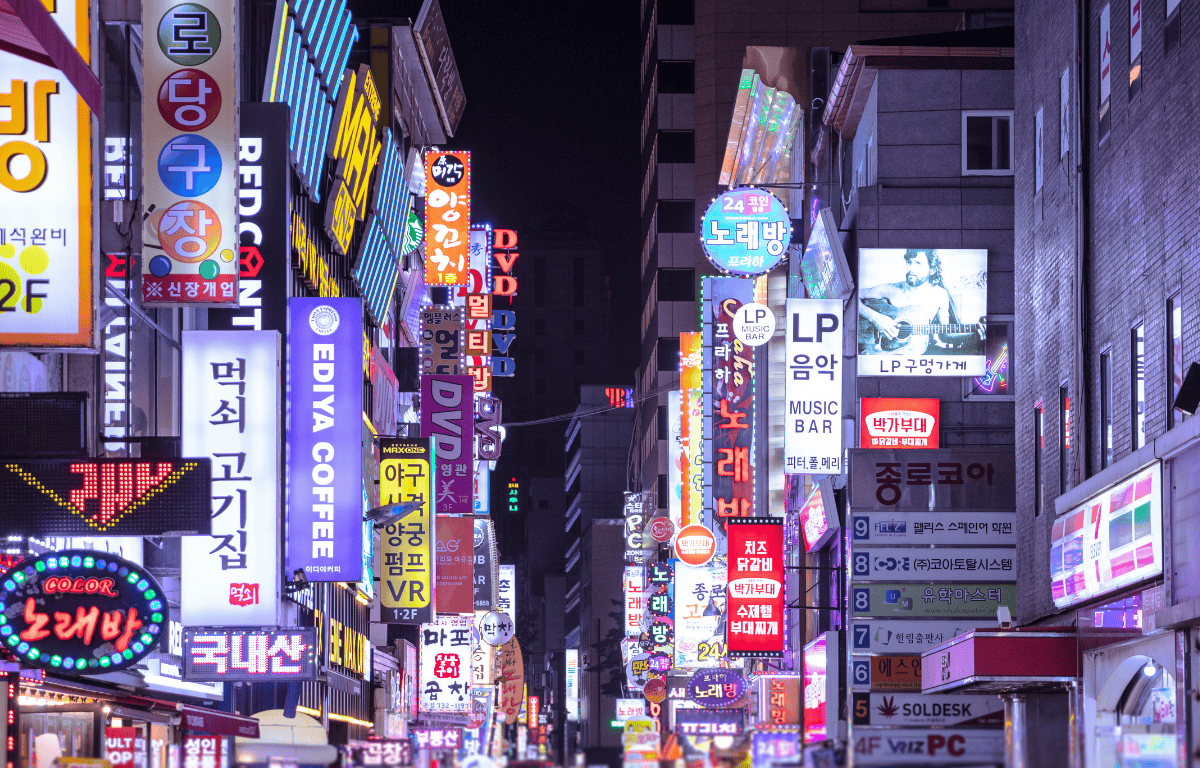
🏙️ Capital: Seoul — home to 10 million people and counting
🗣️ Language: Korean (한국어) — written in the elegant Hangul script
🌶️ Iconic food: Kimchi is eaten at almost every meal — and it’s often vegan!
🌱 Vegan scene: Seoul has one of Asia’s fastest-growing plant-based food scenes
⛩️ Temple food: Buddhist temple cuisine has been vegan for over 1,000 years
⚡ Fun fact: South Korea has the world’s fastest average internet speed
🎭 K-culture: From K-pop to K-drama, South Korea exports culture like few others
🛎️ Hanbok: The traditional Korean dress is still worn proudly at celebrations & ceremonies
💱 Currency Converter
Convert your local currency to Korean Won (₩ KRW)
→
Korean Won (KRW)
—
Fetching live rate…
🗣️ Useful Korean Phrases
Pick a phrase to see how to say it in Korean
Korean
Romanisation
How to pronounce it
안녕하세요AnnyeonghaseyoAHN-nyong-ha-seh-yo — a respectful greeting used any time of day. For friends you can shorten it to annyeong (AHN-nyong).감사합니다GamsahamnidaGAHM-sa-ham-ni-da — formal & polite. Casually: gomawo (고마워) — GOH-ma-wo.주세요(noun) juseyoJOO-seh-yo — attach after what you want. E.g. “mul juseyo” = “water, please.”죄송합니다JoesonghamnidaJWEH-song-ham-ni-da — formal apology or excuse me. Casually: mianhae (미안해) — mee-AHN-heh.저는 비건입니다Jeoneun bigeon-imnidaJOH-neun BEE-gun-im-ni-da — “I am vegan.” Point at menu items and add eomneun geot to say “without” something.고기 벗요Gogi beoyoGOH-gi BEH-yo — “No meat.” Gogi means meat. Also useful: gogi eomneun geot (without meat).생선 벗요Saengson beoyoSENG-son BEH-yo — “No fish.” Important as fish stock is very common in Korean soups & stews.계란 벗요Gyeran beoyoGYEH-ran BEH-yo — “No eggs.” Eggs appear in many Korean dishes, fried rice, and bibimbap.유제품 벗요Yujepum beoyoYOO-jeh-poom BEH-yo — “No dairy.” Yujepum covers milk, cheese & butter as a group.해산물 벗요Haesanmul beoyoHEH-san-mool BEH-yo — “No seafood.” Shrimp & squid are very common in Korean cooking.이거 비건이에요?Igeo bigeonieyo?EE-guh BEE-gun-ee-EH-yo? — “Is this vegan?” Point at the dish or menu item as you ask.맛있어요!Massisseoyo!MAH-shi-ssuh-yo! — “It’s delicious!” Chefs and servers will genuinely appreciate hearing this.식당이 어디에요?Sikdang-i eodieyo?SHIK-dang-ee UH-dee-EH-yo? — “Where is the restaurant?” Sikdang = restaurant.얼마에요?Eolmaeyo?UHL-meh-yo? — “How much is this?” Short and universally understood in any shop or market.물 주세요Mul juseyoMOOL JOO-seh-yo — “Water, please.” Tap water is safe in Korea and usually brought free to the table.